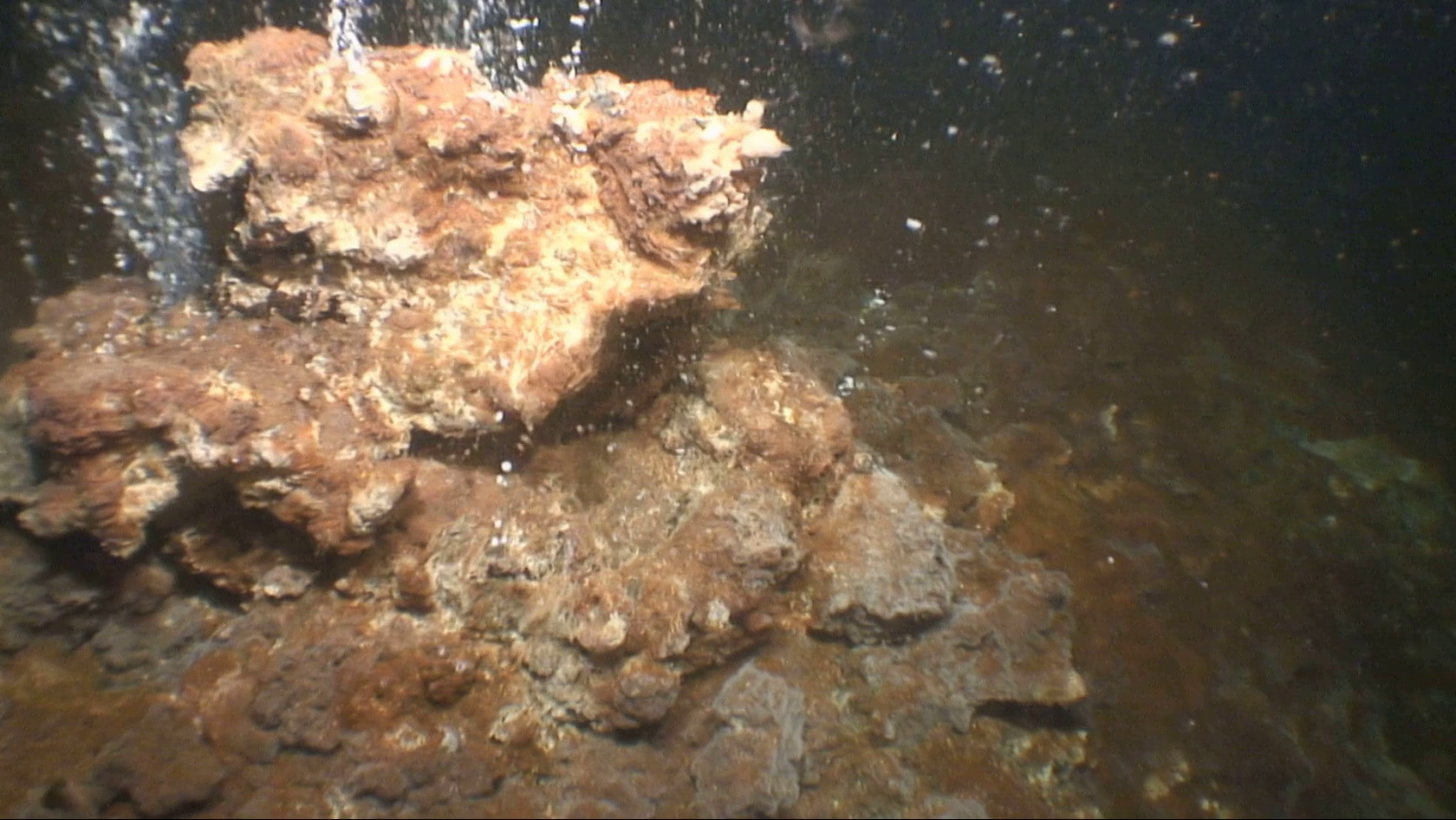
The Christiana‐Santorini‐Kolumbo volcanic field extends for 20 km as a NE‐trending line of more than 20 submarine cones. The largest is Kolumbo, with a 3 km diameter cone‐rim and a 1500 m wide crater situated 505 m below sea level (mbsl). In 2006, actively degassing mounds and chimneys at temperatures up to 265oC, as well as lower temperature vents (with fluids up to 70oC) were discovered in the northern part of the Kolumbo crater. The Kolumbo hydrothermal vent field hosts actively forming, polymetallic (Ag, Hg, As, Tl, Sb, Cu, Pb and Zn) sea‐floor massive sulfide (SMS) deposits, in the form of diffuser chimneys and mounds, emitting boiling CO2‐rich fluids at 265oC, which represents the only known SMS deposits associated with continental margin volcanism.
Santorini volcanic complex has been studied since 2011 in numerous oceanographic expeditions and projects whereas for the first time in the Mediterranean Sea, a seafloor volcanic observatory, the SANTORY Observatory, was developed in the most active submarine volcano, Kolumbo 7 km NE of Santorini Island at 500 m depth within the framework of the SANTORY project.
Supporting the SANTORY Observatory
Within the framework of the BIORESIST project, we will continue our efforts to support SANTORY Observatory and more samples will be collected from the Kolumbo volcano. By using culture‐independent and culture-based techniques we will analyze the Antibiotic Resistance genes present in this environment and we will isolate and sequence microorganisms based on their tolerance to a series of environmental stressors, in order to confirm our previous observations and get additional information on the microbial resistance mechanisms against a series of widely used antibiotics that may pose a great health risk.
Within the framework of the BioResist project we will evaluate the Antibiotic Resistance of microbial communities as a potential hazard that should be included in volcano monitoring projects.
The Christiana‐Santorini‐Kolumbo volcanic field extends for 20 km as a NE‐trending line of more than 20 submarine cones. The largest is Kolumbo, with a 3 km diameter cone‐rim and a 1500 m wide crater situated 505 m below sea level (mbsl). In 2006, actively degassing mounds and chimneys at temperatures up to 265oC, as well as lower temperature vents (with fluids up to 70oC) were discovered in the northern part of the Kolumbo crater. The Kolumbo hydrothermal vent field hosts actively forming, polymetallic (Ag, Hg, As, Tl, Sb, Cu, Pb and Zn) sea‐floor massive sulfide (SMS) deposits, in the form of diffuser chimneys and mounds, emitting boiling CO2‐rich fluids at 265oC, which represents the only known SMS deposits associated with continental margin volcanism.
Santorini volcanic complex has been studied since 2011 in numerous oceanographic expeditions and projects whereas for the first time in the Mediterranean Sea, a seafloor volcanic observatory, the SANTORY Observatory, was developed in the most active submarine volcano, Kolumbo 7 km NE of Santorini Island at 500 m depth within the framework of the SANTORY project.
SUPPORTING THE SANTORY OBSERVATORY
Within the framework of the BIORESIST project, we will continue our efforts to support SANTORY Observatory and more samples will be collected from the Kolumbo volcano. By using culture‐independent and culture-based techniques we will analyze the Antibiotic Resistance genes present in this environment and we will isolate and sequence microorganisms based on their tolerance to a series of environmental stressors, in order to confirm our previous observations and get additional information on the microbial resistance mechanisms against a series of widely used antibiotics that may pose a great health risk.
Within the framework of the BioResist project we will evaluate the Antibiotic Resistance of microbial communities as a potential hazard that should be included in volcano monitoring projects.





© 2026 Bioresist. All Rights Reserved | Web Design by P. Polymenakou